
On 15 July 2026, Parliament’s Committee on Natural Resources, sitting jointly with the Agriculture and Trade and Investment Committees, heard testimony from Dr Napoleon Dzombe, founder and Managing Director of Mtalimanja Holdings, on why his Mulalo Granular Fertiliser Production Factory in Dowa was still not operating (Nyasa Times, 2026a; Malawi Voice, 2026). Dzombe told MPs that prolonged delays in certification and licensing had stalled construction, discouraged prospective investors, and imposed a significant personal and financial toll on him as the project’s initiator (Nyasa Times, 2026a). In the interim, he had partnered with local farmers to source fertiliser from established manufacturers simply to keep faith with the market while awaiting government approval (Nyasa Times, 2026a).
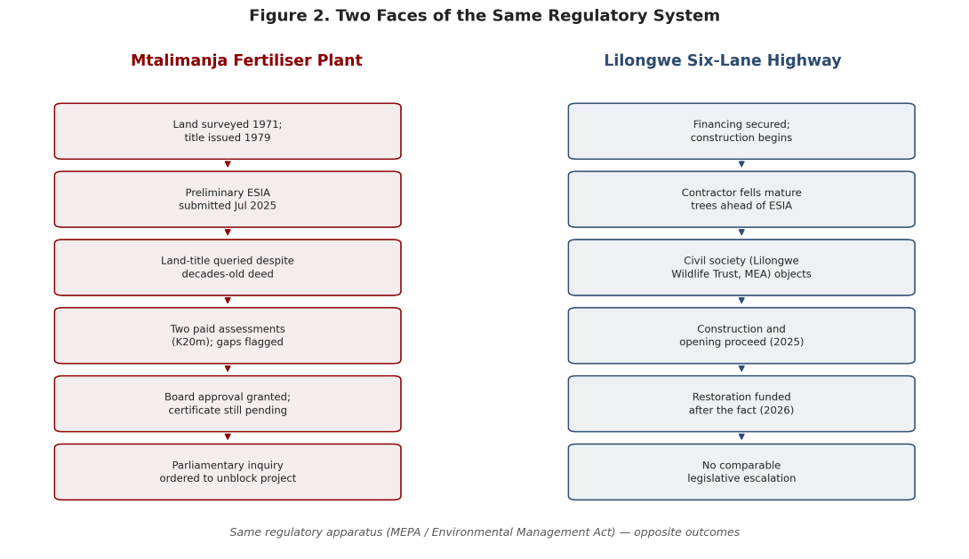
This was not a project stalled for want of capital, technology, or demand. By the developer’s own account, key manufacturing equipment had been installed well ahead of the hearing (Billionaires Africa, 2025). It was stalled in the approval queue. The Malawi Environment Protection Authority’s Executive Director, Dr Wilfred Kadewa, told the committee that the project’s environmental board approval had been granted, with only the environmental certificate outstanding (Malawi24, 2026a). Yet the process had earlier snagged on a land ownership question, notwithstanding that the 26-hectare site had been surveyed as long ago as 1971 and carried a title deed issued in 1979 (Malawi24, 2026a). A landholding older than most of the officials reviewing it was still treated as a live doubt, not diligence, but a system defaulting to suspicion because no one felt able, or safe, to exercise judgment and close the matter.
Dzombe’s testimony went beyond procedural complaint to a direct argument about policy coherence. He questioned why MEPA had charged the company K10 million for each of two required environmental assessments, K20 million in total, arguing that a fee of that size sat awkwardly against the government’s own stated commitment to supporting local investors (Malawi24, 2026c; Malawi Voice, 2026c). He told the committee that no public official had personally solicited money from him, but that the accumulated delays and costs had already dented the project’s standing with banks and other financing partners, and that he had separately lost K500 million on an earlier, failed international bus terminal venture (Malawi24, 2026c). Dzombe added that he had been offered more favourable investment terms in Mozambique, and said the contrast had left him wondering whether he was operating in the wrong country, a local investor trying to build something for Malawi, taxed and delayed as though the state preferred he take the capital elsewhere (Malawi24, 2026c; Malawi Voice, 2026c).
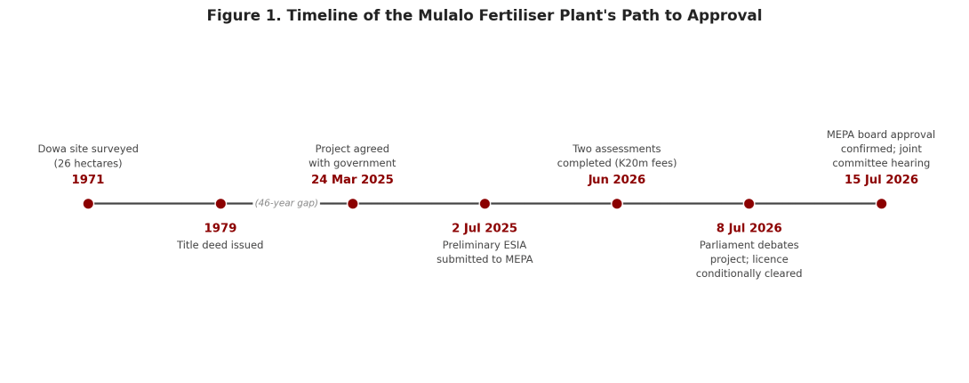
Parliament’s response is itself telling. The joint committee was constituted only after an MP raised the matter on the floor of the House and the Speaker ordered an inquiry (Nation Online, 2026a; Nyasa Times, 2026b). A functioning regulatory environment should not require legislative escalation to bring a fully surveyed, already approved project to completion. That it did in this case is the real story, and it is not unique to fertiliser manufacturing.
A pattern across sectors, not an isolated case.
Mining tells a similar story from a different angle. Malawi’s investment framework formally reserves small-scale and artisanal mining for citizens and gives indigenous bidders a preference in public procurement (U.S. Department of State, 2025). In practice, the ambition has consistently outpaced the machinery built to deliver it. A 60% indigenous preference, written into the 2017 amendment to the Public Procurement and Disposal of Assets Act, was never operationalised; draft Indigenous Black Malawian preference regulations prepared in 2020 were shelved amid pushback, leaving a diluted 20% administrative circular in their place (U.S. Department of State, 2025). Meanwhile, licensing, technical and reporting requirements calibrated for large multinational operators sit awkwardly on small Malawian firms, who typically lack the in-house legal and geological capacity that foreign entrants bring as standard. The result is a sector in which the rules meant to protect local participation are administratively weak, while the rules that burden local entrants are administratively strong. The Mines and Minerals Regulatory Authority, established under the 2023 Act, has a clear statutory mandate to regulate for the benefit of Malawians (Mining and Minerals Regulatory Authority, n.d.), and the government has shown it can act decisively where the political will exists: new mining licences were suspended in early 2026 pending a comprehensive audit of existing permits (African Sustainability Matters, 2026). A related investigation found that entities linked to Chinese state interests had quietly assumed control of a major rare-earth mineral concession without the ownership-change approvals required under Malawian law, exposing weak regulatory capacity even over strategic assets (ICIJ, 2026). The capacity to police these matters closely clearly exists; the question is why it is so rarely available to a local investor waiting on a routine certificate.
Land administration is a third, cross-cutting bottleneck. Malawi’s 2022 land law amendments were intended to protect customary land and indigenous ownership by restricting land transfers to non-citizens and reserving customary estates for indigenous Malawians (U.S. Department of State, 2025). But implementing regulations submitted to the Ministry of Justice for gazetting in January 2024 remained unpublished as of the most recent investment climate assessment (U.S. Department of State, 2025). Investors, local ones especially, who cannot relocate a project to a friendlier jurisdiction are left navigating restrictions on land use, conversion, and leasehold, whose final legal shape nobody can yet point to.
Infrastructure delivery adds a further, instructive dimension, and here the same regulatory apparatus cuts in the opposite direction. Lilongwe’s Dr Saulos Klaus Chilima Highway and Mzimba Street, Malawi’s first six-lane road, running from Kamuzu Central Hospital to Parliament Roundabout, was financed by Standard Bank and Old Mutual and opened by President Chakwera in September 2025 (Maravi Express, 2025). Before it carried that name, it was simply Lilongwe’s six-lane road project, and its construction drew direct and early criticism from environmental civil society. In January 2023, while the road was still under construction, MCP legislator Alfred Jiya and DPP MP Werani Chilenga, chair of Parliament’s Climate Change Committee and leader of the Malawi Parliamentary Conservation Caucus (MPCC), used a joint tree-planting event at the Area 18 interchange to draw public attention to what Jiya termed a prior incident in which the contractor had begun removing mature Mbawa trees for the six-lane road project before an Environmental and Social Impact Assessment report was in place (AfricaBrief, 2023). Lilongwe Wildlife Trust and the Movement for Environmental Action were credited with having pressed the issue; the Movement’s Mala Kayira used the same platform to call on Lilongwe City Council to reclaim green spaces she said had been improperly allocated to developers, while Lilongwe Wildlife Trust’s Dorothy Tembo Nhlema called for the council to set clear species and budget guidelines so that future restoration was planned rather than ad hoc (AfricaBrief, 2023).
The pattern this exposed did not end with the 2023 controversy. The highway opened in September 2025 with its tree cover not yet restored, and remediation continued well after ribbon-cutting: a Rotary Club of Lilongwe planting drive in January 2026 and Standard Bank’s K50 million Mtengo Wanga programme, launched on Earth Day in April 2026, were both framed explicitly as restoring vegetation lost during construction of the highway and Mzimba Street (Zodiak Malawi, 2026; Malawi Voice, 2026b; Nation Online, 2026b). Separately, environmental assessment of the wider M1 corridor through Lilongwe, of which this highway forms part, has documented recurring sensitive features along this class of road, including wetlands, granite outcrops, mature trees within the road reserve, and graves in close proximity to the carriageway (European Investment Bank, n.d.). None of this is to say the highway should not have been built; connectivity between the city centre, Kamuzu Central Hospital and the central business district is a legitimate public good, and the Roads Fund Administration has itself acknowledged that trees were removed during construction (Malawi Voice, 2026b). The point is the asymmetry it reveals: a state-backed flagship project proceeded through tree felling ahead of its own ESIA, drawing two years of civil-society pressure before restoration followed, while a private agro-industrial investor with a forty-seven-year-old, undisputed title deed spent years waiting for a routine certificate on a project whose environmental board approval had already been granted. Regulatory friction in Malawi is not simply heavy; it is applied unevenly and unpredictably, and it does not fall hardest on the projects that pose the greatest environmental risk.
The same unevenness appears elsewhere in the sector. The late Vice President Saulos Chilima, in his capacity as overseer of public infrastructure, publicly criticised the quality of Malawian road and bridge works, citing the failed bridge embankment at Chapananga in Chikwawa and the collapsed Biti Kalanje bridge in Mangochi as evidence of a system that tolerates substandard delivery (Nyasa Times, 2021). He linked the problem partly to procurement practice: contracts routinely go to the lowest bidder, which one commentator at the time described as diluting engineering standards into what was called a rushed, corner-cutting job (Nyasa Times, 2021). Here, the regulatory failure runs the other way, not excessive caution over a paperwork technicality, but insufficient rigour over the structural safety questions that actually matter. Mechanical regulation, in other words, does not reliably produce either outcome: it can generate exhaustive scrutiny of a settled land title while waving through an engineering design on price alone.
Borrowed blueprints: When imported rules meet local capacity.
Part of why these rules get applied so mechanically is that many of them were not built from Malawi’s own institutional experience in the first place; they were substantially imported. A World Bank comparative study of environmental impact assessment law across the region found that Sub-Saharan African states had copied the basic principles and rules of their EIA systems from well-established frameworks in developed countries, with domestic legal traditions and international environmental law trends layered on top rather than driving the design (Bekhechi and Mercier, 2002). Malawi’s own Environmental Management Act and its ESIA guidelines sit within that same lineage. So does its company law, built around full International Financial Reporting Standards adopted by the accounting profession in 2001, a reporting architecture designed principally for globally listed firms, and much of its investment and procurement legislation, drafted with heavy donor and multilateral technical input (U.S. Department of State, 2025).
This is not a uniquely Malawian problem, but a retrospective World Bank review of Malawi’s own reform history gave it a name worth borrowing: isomorphic mimicry, the tendency for reform initiatives to produce institutions that look like those found in higher-performing countries without acquiring the same underlying functionality (Bridges and Woolcock, 2017). The same review noted a recurring criticism among Malawian scholars that donor-supported reforms have at times transferred institutions and procedures into a value system that cannot readily absorb them, producing what one described as a fundamental misfit between the reform and the context meant to carry it (Bridges and Woolcock, 2017). A separate, World Bank-funded technical assessment of Malawi’s building regulations reached a strikingly similar conclusion in narrower terms, recommending, as a priority, that the country move toward a building regulatory system tailored to the local context, an implicit admission that the one in use had not been (World Bank, 2024).
The consequence for the cases already discussed is direct. An ESIA process modelled on systems built for jurisdictions with well-resourced regulators, standing technical registries and predictable land records is then run, in Malawi, by agencies that are themselves under-capacitated, which is precisely the combination that produces both extremes documented above: exhaustive, risk-averse scrutiny of a settled land title, because the officials reviewing it have neither the authority nor the institutional confidence to close out a borrowed procedure early, and simultaneous silence on a flagship project’s own tree felling, because enforcement discretion was never built into the transplanted rule to begin with. Land reform shows the same dynamic on a policy level: Malawi’s 2022 land amendments echo a global template of indigenous land protection and foreign-ownership restriction that has circulated across the region, yet the implementing regulations needed to operationalise it domestically remain unpublished more than two years on (U.S. Department of State, 2025), the imported template arrived faster than the local capacity to run it.
None of this argues for rejecting international standards. Malawi’s trade, investment and environmental commitments require a degree of convergence with global norms, and some imported principles, transparent ownership disclosure in mining, for instance, are exactly what the country needs enforced, not diluted. The point is narrower: a rule copied wholesale from a different institutional context, without a deliberate localisation step that maps which parts fit Malawian capacity and which need to be substituted or simplified, does not give an official anything usable to exercise judgment with. It gives them a foreign checklist and a mandate to apply it mechanically, which is precisely the failure mode this article has been describing.
The case for judgment, not just rules.
None of this is an argument against regulation. Land titles need verification, hazardous chemical handling needs oversight, mineral wealth needs protecting from undisclosed ownership transfers, and road and bridge works need engineering rigour that a lowest-price tender cannot guarantee on its own. The argument is against regulation applied mechanically, as a checklist executed by officials with no room, or no confidence, to exercise discretion once the substantive concern has genuinely been addressed, and no obligation to apply that same rigour where the underlying risk is real rather than procedural.
A title deed forty-seven years old should not be subject to the same scrutiny as an unregistered customary claim. A project with a completed and board-approved environmental assessment should not wait indefinitely for a certificate that is, procedurally, a formality. A local investor operating in a sector where policy explicitly favours indigenous participation should not find that preference weaker in practice than the rules working against them. And a bridge should not fail because the tender process rewarded the cheapest bid over the soundest one.
Recommendations
Five changes would help close this gap. First, statutory timelines with automatic escalation: once an agency has cleared its substantive concerns, a certificate or licence should be issued within a fixed window, with a named accountable officer if it is not. Second, risk-tiered assessment, so that environmental and social impact review scales to the actual hazard profile of a project rather than treating every application, a settled agribusiness title and a greenfield chemical plant alike, identically. Third, outcome-based standards for public infrastructure procurement, so that engineering quality is weighted against price rather than subordinated to it, closing the gap that produced the Chapananga and Biti Kalanje failures. Fourth, a localisation review of substantially imported regulatory frameworks, an explicit, published assessment of which provisions of a borrowed template (in EIA law, company reporting, or land administration) match Malawian institutional capacity and which need domestic substitution, rather than treating the transplanted text as self-executing. Fifth, and most fundamentally, empowering the officials who sit closest to these decisions to exercise professional judgment, and protecting them for doing so, rather than incentivising every case to be pushed upward, or sideways, until it lands, as the Mtalimanja matter did, on the floor of Parliament.
Conclusion
Dr Dzombe’s testimony will likely produce a committee report, some recommendations, and perhaps, at last, a certificate. That is a good outcome for one factory. It is not a system. The measure of whether Malawi has actually addressed over-regulation will be whether the next local investor with a proposal, a decades-old title deed, and a completed environmental review gets an answer in weeks rather than years, without needing a Speaker’s ruling to get there. Equally, it will be whether the next bridge is built to standard because regulation demanded it, not despite regulation having waved it through.
References.
African Sustainability Matters (2026) ‘Malawi suspends mining licences, bans raw mineral exports in major sector reform’, African Sustainability Matters, 25 March. Available at: https://africasustainabilitymatters.com/malawi-suspends-mining-licences-bans-raw-mineral-exports-in-major-sector-reform/ (Accessed: 15 July 2026).
AfricaBrief (2023) ‘Chilembwe Day celebration brings together politicians and community to plant trees, boost Lilongwe’s greening efforts’, AfricaBrief, 16 January. Available at: https://africabrief.substack.com/p/chilembwe-day-celebration-brings (Accessed: 15 July 2026).
Bekhechi, M.A. and Mercier, J-R. (2002) The Legal and Regulatory Framework for Environmental Impact Assessments: A Study of Selected Countries in Sub-Saharan Africa. Washington, DC: World Bank, Law, Justice and Development Series. Available at: https://documents1.worldbank.org/curated/en/573451468002164226/pdf/multi0page.pdf (Accessed: 15 July 2026).
Billionaires Africa (2025) ‘Napoleon Dzombe to launch Dowa fertilizer plant in 2026’, Billionaires Africa, 30 December. Available at: https://www.billionaires.africa/2025/12/30/malawian-businessman-napoleon-dzombe-dowa-fertilizer-plant-2026/ (Accessed: 15 July 2026).
Bridges, K. and Woolcock, M. (2017) How (Not) to Fix Problems That Matter: Assessing and Responding to Malawi’s History of Institutional Reform. Policy Research Working Paper 8289. Washington, DC: World Bank. Available at: https://openknowledge.worldbank.org/entities/publication/fbbe9638-d16e-58bf-8c80-ed272318fb8d (Accessed: 15 July 2026).
European Investment Bank (n.d.) Environmental and Social Impact Assessment for the Proposed Rehabilitation of the M1 Road. Available at: https://www.eib.org/attachments/registers/157358099.pdf (Accessed: 15 July 2026).
ICIJ (2026) ‘Investigation reveals how Chinese firms blindsided Malawian government over strategic mine ownership’, International Consortium of Investigative Journalists, 4 February. Available at: https://www.icij.org/news/2026/02/investigation-reveals-how-chinese-firms-blindsided-malawian-government-over-strategic-mine-ownership/ (Accessed: 15 July 2026).
Malawi24 (2026a) ‘Dzombe fertiliser plant moves closer to reality’, Malawi24, 15 July. Available at: https://malawi24.com/2026/07/15/dzombe-fertiliser-plant-moves-closer-to-reality/ (Accessed: 15 July 2026).
Malawi24 (2026b) ‘Government clears path for Dzombe fertilizer plant licence’, Malawi24, 8 July. Available at: https://malawi24.com/2026/07/08/government-clears-path-for-dzombe-fertilizer-plant-licence/ (Accessed: 15 July 2026).
Malawi24 (2026c) ‘Dzombe criticises delays in fertiliser factory approval’, Malawi24, 15 July. Available at: https://malawi24.com/2026/07/15/dzombe-criticises-delays-in-fertiliser-factory-approval/ (Accessed: 15 July 2026).
Malawi Voice (2026a) ‘Malawi Parliament kicks off inquiry into delayed Dowa fertilizer plant approval’, Malawi Voice, 15 July. Available at: https://www.malawivoice.com/2026/07/15/malawi-parliament-kicks-off-inquiry-into-delayed-dowa-fertilizer-plant-approval/ (Accessed: 15 July 2026).
Malawi Voice (2026b) ‘Standard Bank plants trees on Dr Saulos Chilima Highway’, Malawi Voice, 22 April. Available at: https://www.malawivoice.com/2026/04/22/standard-bank-plants-trees-on-dr-saulos-chilima-highway/ (Accessed: 15 July 2026).
Malawi Voice (2026c) ‘Local investor Napoleon Dzombe criticises Malawi’s investment environment’, Malawi Voice, 15 July. Available at: https://www.malawivoice.com/2026/07/15/local-investor-napoleon-dzombe-criticises-malawis-investment-environment/ (Accessed: 15 July 2026).
Maravi Express (2025) ‘President Chakwera officially opens Saulos Klaus Chilima Highway and Mzimba Street’, Maravi Express, 13 September. Available at: https://www.maraviexpress.com/president-chakwera-officially-opens-saulos-klaus-chilima-highway-and-mzimba-street/ (Accessed: 15 July 2026).
Mining and Minerals Regulatory Authority (n.d.) About the Authority. Available at: https://www.mmra.mw/ (Accessed: 15 July 2026).
Nation Online (2026a) ‘Speaker orders joint probe into Dzombe’s fertiliser project’, The Nation, July. Available at: https://mwnation.com/speaker-orders-joint-probe-into-dzombes-fertiliser-project/ (Accessed: 15 July 2026).
Nation Online (2026b) ‘Standard Bank pledges K50m to replant trees in Lilongwe’, The Nation, 23 April. Available at: https://mwnation.com/standard-bank-pledges-k50m-to-replant-trees-in-lilongwe/ (Accessed: 15 July 2026).
Nyasa Times (2021) ‘Malawi VP Chilima challenges engineers to up standards’, Nyasa Times, 26 February. Available at: https://www.nyasatimes.com/malawi-vp-chilima-challenges-engineers-to-up-standards/ (Accessed: 15 July 2026).
Nyasa Times (2026a) ‘Delays to Dowa fertiliser plant have taken personal and financial toll, MPs told’, Nyasa Times, 15 July. Available at: https://www.nyasatimes.com/delays-to-dowa-fertiliser-plant-have-taken-personal-and-financial-toll-mps-told/ (Accessed: 15 July 2026).
Nyasa Times (2026b) ‘Speaker sets up parliamentary committee to probe delays to Dowa fertiliser plant’, Nyasa Times, 13 July. Available at: https://www.nyasatimes.com/speaker-sets-up-parliamentary-committee-to-probe-delays-to-dowa-fertiliser-plant/ (Accessed: 15 July 2026).
U.S. Department of State (2025) 2025 Investment Climate Statements: Malawi. Available at: https://www.state.gov/reports/2025-investment-climate-statements/malawi (Accessed: 15 July 2026).
World Bank (2024) ‘Building a safer, healthier, more resilient Malawi’, World Bank Blogs: Africa Can End Poverty, 16 March. Available at: https://blogs.worldbank.org/en/africacan/building-safer-healthier-more-resilient-malawi (Accessed: 15 July 2026).
Zodiak Malawi (2026) ‘Rotary Club of Lilongwe plants 200 Mbawa trees along Saulos Chilima Highway’, Zodiak Malawi, 23 January. Available at: https://zodiakmalawi.com/national-news/news-in-the-central-region/rotary-club-of-lilongwe-plants-200-mbawa-trees-along-saulos-chilima-highway (Accessed: 15 July 2026).
Leave a Reply